The Books Must Balance
The Accounting Equation

Beginner Again
A couple of months ago, I knew nothing about accounting. Not the concepts, not the purpose, not even why accountants exist. All I knew was that accountants are people who crunch numbers all day.
My company builds AI products and services for Saudi SMEs, and when I went researching which domains we could serve next, accounting kept surfacing — bookkeepers, CPAs, accounting firms, again and again. But every attempt to understand their domain, business and workflows hit the same wall: this is a profession whose real knowledge lives in practice, not in books. It’s passed from senior to junior, guarded the way every craft guards the skills that feed its people. From the outside, you see the beautiful well-aligned reports; you never see the ugly grind.
So I made the only decision that made sense: if I were to build for this profession, I have to learn it myself. I’m taking courses, and I’m fortunate to have practicing accountants patiently answering my sloppy beginner questions. These posts are my notes and build story — written so I can return to them for reference and motivation.
Before Excel
The obvious way to track money is a list. Money in, money out — a checkbook. Accountants call this single-entry bookkeeping, and it has two fatal flaws. It can tell you what flowed, but never where you stand — what you own versus what you owe. And when a mistake creeps in, nothing in the list will ever tell you. A wrong number just sits there, looking exactly like a right one.
Italian merchants outgrew the list somewhere around the 1300s. They were trading across seas, borrowing, lending, and running partnerships — and they needed records that could answer harder questions and catch their own errors. What they evolved is double-entry bookkeeping: every transaction recorded in two places, so the books constantly check themselves.
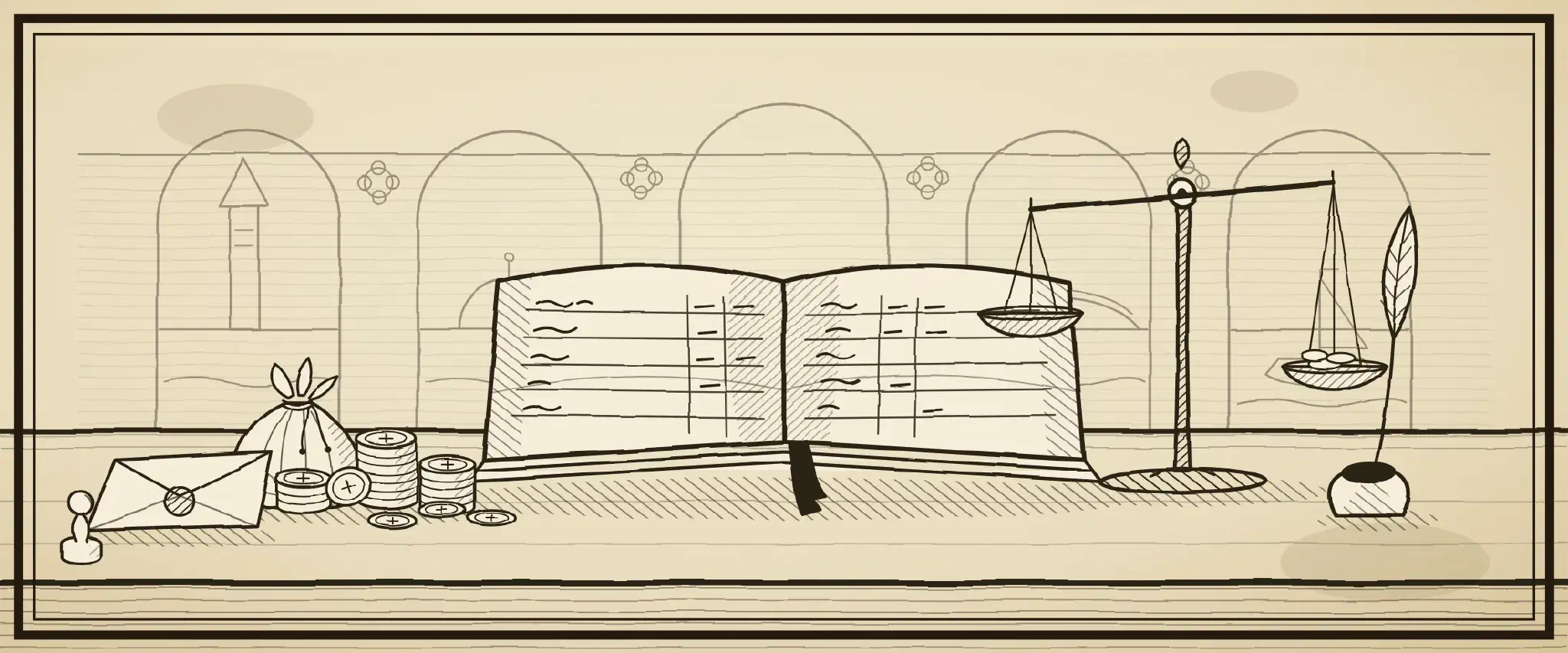
In 1494, a Franciscan friar and mathematician named Luca Pacioli — a friend of Leonardo da Vinci — gave the method its first printed description. He didn’t invent it; he wrote down what Venetian merchants had been perfecting for a century. The method he described is, in its bones, the one every accountant alive uses today.
Venice doesn’t own the whole story, either. Centuries earlier, the early Islamic state ran its finances through the dīwān — entire bureaus built around meticulous registers of revenue and payment. This part of the world was keeping serious books long before the Medici opened theirs.
And underneath five hundred years of this method sits a single equation.
The Equation
Assets = Liabilities + Owner’s Equity
That’s it. That is the foundation the entire profession stands on.
Assets are what the business controls — cash, equipment, inventory, money owed to it by customers. Liabilities are outsiders’ claims on the business — loans, unpaid bills. Owner’s equity is the owners’ claim — what belongs to them after everyone else is accounted for.
I met this equation early in the first course I bought, and I remember the feeling more than the lesson: an assuring calm. This domain I had been circling for weeks — the jargon, the reports, the guarded workflows — all of it builds up from this one simple statement. Learn this, and everything after it is elaboration.
Stated like that, it sounds like a rule someone decreed and accountants obey. It isn’t — and seeing why is the moment accounting stopped being intimidating for me.
Try to Break It
My first reaction to that claim was an objection: of course it’s a rule. Accountants follow it, auditors check it, everyone obeys it. That’s what rules are.
So try to break it! A business holds 100,000 SAR in assets and owes the bank 30,000. What’s the equity? 70,000 — but notice why. Not because a rule commands it. Because that is what the words mean: equity is whatever remains of the assets after outside claims. Write 60,000 in the books if you like — you haven’t broken the equation, you’ve written a false sentence about a business whose equity is still 70,000. The equation can’t be violated any more than “profit equals revenue minus expenses” can. It isn’t a law to obey; it’s a definition wearing the costume of a law.
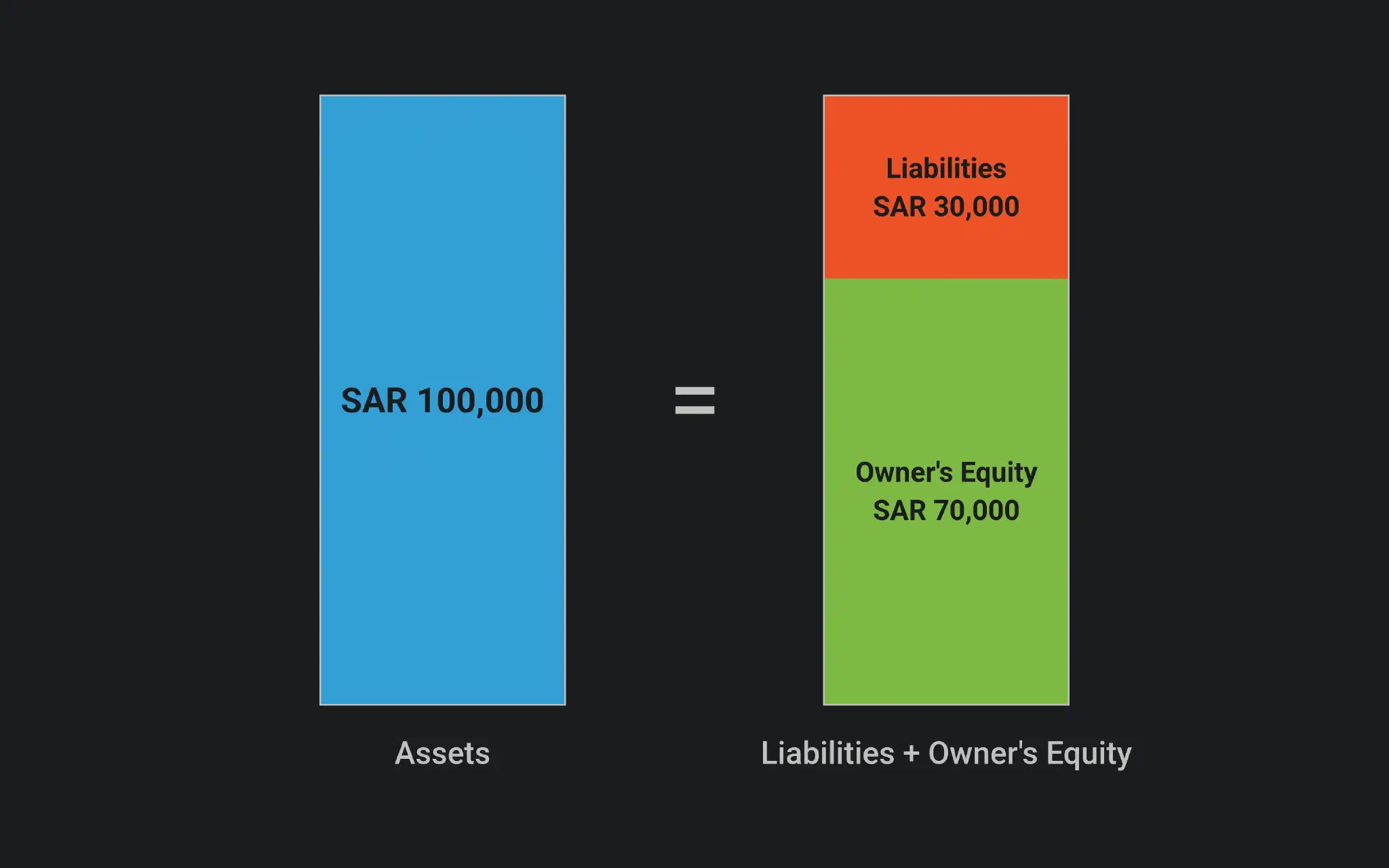
Cut a pie into slices. The slices sum to the pie — is that a rule the pie obeys? The equation is the same arithmetic: assets are the pie, and the right side is the same pie sliced by ownership — the lenders’ piece and the owners’ piece. The two sides are not two quantities that happen to agree. They are the same money counted from two directions: what does the business hold and who has a claim on it. Count one pile twice and the totals must match.
But my objection wasn’t entirely wrong — there is a rule, and accountants do obey it. It just isn’t the equation. The rule is the recording discipline: enter every transaction so that both views stay in sync. Reality always satisfies the equation — by definition, it can’t do otherwise. The books, though, are a human description of that reality, and humans slip. When an accountant says the books don’t balance, it never means the business broke the equation. It means the description contains an error — and the error just announced itself, because the underlying equality cannot actually be false.
That’s the double meaning built into this post’s title. The books must balance — the discipline accountants live by. And the books must balance — because they cannot do otherwise.
The Equation Under Fire
Before watching the equation work, one assumption has to lock in — and it’s the one founders struggle with most: the business is a separate entity from you. Accountants call this the business entity assumption, and it’s not philosophical fine print. The moment founding capital is deposited, that money stops belonging to the founder. It becomes the company’s asset — and the founder becomes a claimant on the company, holding equity, standing in line behind every lender. Without that boundary around the business, there is nothing to count. The books belong to the entity, not to you.
With the boundary drawn, watch the equation survive contact with real life. Take a small business — say a specialty coffee cart in Riyadh — through its first four money events:
| What happened | Assets | = | Liabilities | + | Equity |
|---|---|---|---|---|---|
| Owner deposits 50,000 SAR of her savings | 50,000 | = | 0 | + | 50,000 |
| Bank lends the business 30,000 SAR | 80,000 | = | 30,000 | + | 50,000 |
| Buys an espresso machine for 20,000 cash | 80,000 | = | 30,000 | + | 50,000 |
| Repays 10,000 SAR of the loan | 70,000 | = | 20,000 | + | 50,000 |
Every event moves the numbers. No event breaks the equality.
The third row is my favorite. The machine purchase changes nothing on the right side — 20,000 of cash becomes 20,000 of equipment, one asset swapped for another, and the claims on the business didn’t so much as flinch. The day that row made sense to me, the whole equation had.
What Equity Actually Means
As a founder, I thought I already knew equity — ownership, shares, the cap table, who holds what percent. Accounting’s definition is starker and, I now think, more honest: equity is what remains. Assets minus liabilities. Nobody ever deposits “equity” into a business; it isn’t a pile of its own. It’s the answer to a subtraction.
Look back at the table. After the owner’s first deposit, the equity column never moves again — the loan arrives, the machine is bought, the debt is repaid, and the owner’s 50,000 sits untouched. Not because equity is frozen, but because every one of those events changed the assets and the outside claims by exactly the same amount. The leftover didn’t change because nothing happened that could change it.
So what does move equity? Only two things, it turns out. The owners themselves — putting more in, or taking some out. And the business earning or losing money — which is a story about revenue and expenses, where they hide inside this equation, and why the books need “closing” at all. That story is a few posts away.
Once you read it this way, a balance sheet stops being a report and becomes a sentence: here is what the business holds, here is who else has claims, and here is what’s left for the owners. Growing a business means growing the leftover. Everything else is means.
What Comes Next
An equation that must survive every transaction needs a discipline that enforces it — one entry at a time, thousands of times a year. That discipline is double-entry’s famous machinery: debits and credits. I came to this subject fearing those two words, and I now suspect they are the most misunderstood words in business — because everyone’s intuition about them was installed by their bank statement, and the bank was talking about its own books, not yours!
That’s the next post.